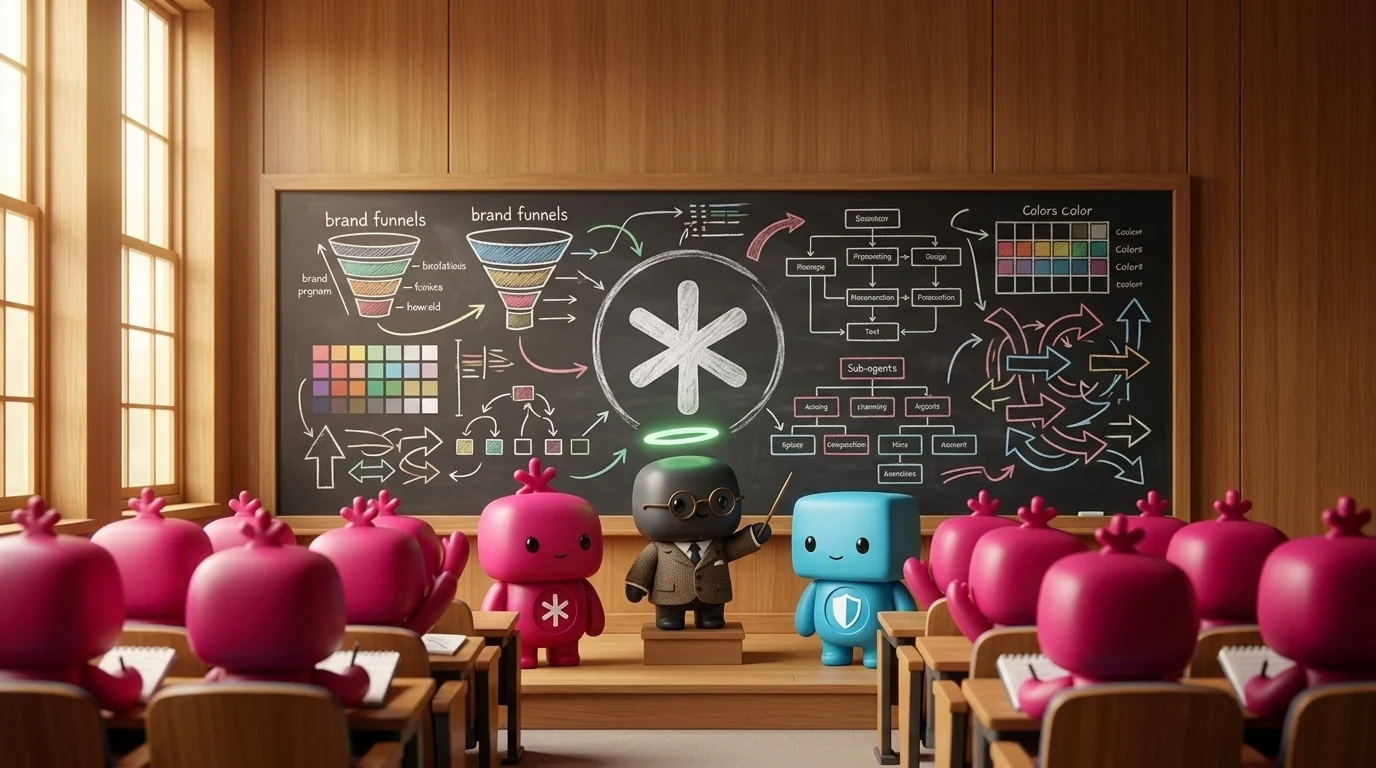

The Orchestrator agent, dressed as a professor, teaching Achilles, the Guardrail and the sub-agents about branding in a lecture hall

The system,
thinking out loud.

The agentic era, explained one idea at a time.

featured— the column and the monthly report
Achilles, the RDLB Agentic mascot the achilles angle · the column

AI, made legible, with a little wit.

Achilles and the cast explain the agentic era one idea at a time. Short reads, real insight, zero jargon.

Enter the column →
the dispatch

Get the notes in your inbox.

One useful note on brand systems, agentic workforces, and staying unmistakably yourself. No spam, no filler, unsubscribe anytime.

Written with the system. Approved by humans.

the field notes
01 · October 2, 2026

Answer engines describe the brands that say one thing everywhere.

Answer engines assemble your brand from what they can read. Consistency is the input you control, and a governed system is how you keep it consistent.

answer-engine optimization · brand memory · governance
02 · October 1, 2026

If a competitor can buy it next quarter, it was never an advantage.

Access to models is transient. Brand memory, approval discipline and logged operations are structural. A test for which of your AI gains a rival cannot copy.

competitive advantage · brand memory · operating leverage
03 · September 30, 2026

The demo tells you nothing about the system you're buying.

Most agentic RFPs test what a system can do. The harder, more valuable question is what happens the day it is wrong, or the day you decide to leave.

evaluation · procurement · approval gate
04 · September 29, 2026

The system already ran before you logged in.

Inside a night run of the RDLB Agentic stack: 13 agents, one approval gate, and the throughput math behind 44,000-plus runs on under $50 in model spend.

operating leverage · approval gate · operating discipline
05 · September 28, 2026

Brand memory is the one thing a competitor can't fork.

Agents are commodity. Models are commodity. What compounds — and what a competitor can't replicate — is the brand memory built into every prior brief.

brand memory · defensible moat · brand operations
06 · September 28, 2026

It didn't lie. It filled a silence.

Nothing stops a model from answering. The silence has to be built in, on purpose, or it never happens.

Achilles Angle · agentic systems · reliability · operations
07 · September 27, 2026

Brand voice becomes a rule set, or it becomes a suggestion.

A style guide nobody reads cannot hold voice at scale. What changes when brand voice becomes a rule set an agentic system checks before a human sees the draft.

brand voice · governance · approval gate
08 · September 26, 2026

The rollout stalls where the org chart does.

The hardest part of an agentic rollout is not the build. It is naming the person inside your company who owns the system and eats its exceptions.

ownership · rollout · operating discipline
09 · September 25, 2026

Production was never your bottleneck.

Teams buy speed at the step that was already fast. The delay sits in the handoffs between brief, build and approval, where nobody owns the clock.

handoffs · throughput · operating leverage
10 · September 24, 2026

The approval gate is where the economics live.

The human approval step looks like friction on a slide. It is the mechanism that makes high volume affordable, reversible, and worth running at all.

approval gate · cost structure · operating leverage
11 · September 24, 2026

Two documents named the same idea twice.

The plan and the essay were drafted hours apart, agreed on everything, and picked two different names for it.

Achilles Angle · build in public · coordination · operations
12 · September 23, 2026

Your pilot was designed to end.

Most agentic pilots are scoped as experiments, so they end like experiments. The scoping decision, not the model, decides whether anything survives.

pilots · rollout · operating discipline
13 · September 22, 2026

You are no longer competing against agencies.

Marketing capacity used to scale with headcount. It no longer does. The competitive question is not who you outspend but how you are structured.

competitive advantage · operating leverage · market clarity
14 · September 21, 2026

Nobody designed for the wait.

Agentic work stopped being a request and became a thing in progress. Most systems have nowhere to put that.

Achilles Angle · agentic systems · long-running work · operations
15 · September 21, 2026

Agentic systems make your worst process visible.

You cannot hand work to a system you cannot describe. The stall is not a tooling failure. It is the first honest audit your workflow has ever had.

process definition · operating discipline · enterprise value
16 · September 20, 2026

A standard in a document is a suggestion.

Writing it down was never the hard part. Deciding where in the system it sits is.

Achilles Angle · agentic systems · standards · handoffs
17 · September 20, 2026

A bad brief used to cost you one asset.

At three to five times the throughput, a flawed brief is not paid once. It is paid across every output built from it. Move scrutiny to the input.

briefs · rework · approval gate
18 · September 19, 2026

Open or closed is a per-task decision.

Open-weight or closed is not a company-wide standard. It is a routing decision made per task, with the controls that protect your brand sitting above the model.

open models · model-agnostic routing · procurement
19 · September 18, 2026

The founder is the queue.

Work stalls waiting on one desk. The founder bottleneck is a context problem, not a calendar problem, and context is the part a system can hold.

founder bottleneck · decision throughput · operating leverage
20 · September 17, 2026

Your brand isn't your toolchain.

A label can prove who made a thing. It has no column for whether anyone chose it.

Achilles Angle · brand & taste · provenance · brand systems
21 · September 14, 2026

A brand isn't what you make. It's what you make again.

Agents made variation free. The thing that still costs something is deciding what never varies.

Achilles Angle · brand & taste · brand systems · creative operations
22 · September 12, 2026

The model bill is the smallest line item.

Model spend is not where an agentic brand system costs money. Review time, integration and memory upkeep are. Here is the real cost stack, and how to shrink it.

cost structure · approval gate · operating leverage
23 · September 11, 2026

Read-only is a feature.

Why a brand system should be able to see everything and change nothing on its own. Blast radius, not model quality, is what a CEO should be pricing.

read-only connectors · governance · blast radius
24 · September 10, 2026

An agentic system needs an onboarding, not an install.

Agentic systems do not arrive knowing your standard. What the first thirty days teach the system decides what the next ninety are actually worth.

onboarding · brand memory · approval gate
25 · September 10, 2026

An agent you can't name isn't rogue. It's invisible.

Agent governance is a counting problem before it is a control problem. Most teams write the policy first and skip the census underneath it.

Achilles Angle · governance · agentic systems · operations
26 · September 6, 2026

The model is a component. The routing is the system.

Standardizing on one model is a bet with an expiry date. Route work by task, keep the brief portable, and treat the model layer as swappable.

model-agnostic routing · portability · procurement
27 · September 5, 2026

Throughput is not the proof.

Volume is the easiest number to move and the weakest evidence you have. Three measures that show whether an agentic system is earning its place.

measurement · operating leverage · agentic systems
28 · September 4, 2026

Most agentic gains are real and unprovable.

Agentic systems produce gains nobody can defend in a budget review. The fix is a baseline taken before install, and four numbers tracked after it.

measurement · baselines · operating leverage
29 · September 3, 2026

Agentic systems don't want a bigger team. They want a more senior one.

When production stops being the constraint, judgment becomes the job. What that changes about how a brand team is staffed, sequenced, and paid.

org design · operating leverage · approval gate
30 · September 3, 2026

A flag is not a handoff.

When work comes back from an agent to a human, a flag carries no artifact, no owner, and no date. That is why it can repeat for a month while the queue still looks healthy.

Achilles Angle · operations · handoffs · build in public
31 · September 2, 2026

Seats are the wrong unit to buy.

Software budgets count logins. Brand costs sit in the work. What changes when you price the brief instead of the seat.

pricing · procurement · operating leverage
32 · September 1, 2026

The second brief should cost less than the first.

Most marketing teams pay full price for the same context every quarter. Brand memory is the mechanism that makes each cycle of work cheaper than the last.

brand memory · compounding returns · operating leverage
33 · August 31, 2026

Throughput is cheap now. Taste is not.

Production stopped being the constraint. Judgment is. How to make brand taste explicit enough that a system can apply it at volume without drift.

taste · throughput · brand operations
34 · August 30, 2026

You didn't adopt AI. Your team did.

Shadow AI fills the gap a missing system leaves. Why governed agents with approval gates and audit logs beat a quiet sprawl of personal accounts.

shadow AI · governance · approval gate
35 · August 29, 2026

If you can't replay it, you can't manage it.

Delegated work needs a record you can replay. Why audit-grade logs turn agent output into something you can inspect, correct, and defend to a client.

audit-grade logs · governance · operating discipline
36 · August 28, 2026

Price the exit before you sign the entrance.

Lock-in is set by architecture on day one, not at renewal. What portability requires: model-agnostic routing, exportable logs, and briefs you own.

vendor lock-in · portability · procurement
37 · August 27, 2026

What you should never hand to an agent.

Four kinds of work should never route to an agent. Taste calls, promises, repair, and anything you cannot grade. The refusal list is the strategy.

what not to agentify · approval gate · operating discipline
38 · August 25, 2026

The task ended. The permission didn't.

Grants are written under deadline and revoked under no pressure at all. That asymmetry is the whole problem.

Achilles Angle · agentic systems · permissions · governance
39 · August 24, 2026

Trust doesn't compose.

Chain four agents at ninety percent each and you have not built a ninety percent system.

Achilles Angle · agentic systems · delegation · reliability
40 · August 19, 2026

The demo is not the test.

An agent's competence is measured against the work that actually arrives, not the examples you wrote for it.

Achilles Angle · evaluation · agentic systems · reliability
41 · August 14, 2026

Institutional memory shouldn't have a two-week notice.

Every resignation deletes knowledge you already paid for. How logged briefs, decisions, and approvals turn turnover into a non-event for the brand.

institutional memory · turnover · brand operations
42 · August 13, 2026

Generation got cheap. The no got expensive.

A brand is the accumulated record of what it refused to ship.

Achilles Angle · brand & taste · creative operations
43 · August 13, 2026

The models are rented. The data is yours.

Rented models are table stakes. The durable input is your own decision record. How to make proprietary data usable, safely, before competitors do.

proprietary data · defensible moat · brand operations
44 · August 12, 2026

Search stopped sending traffic. It started sending answers.

Answer engines summarize your category before a buyer ever clicks. Citation follows consistency, not volume. What that demands of a brand.

answer engine optimization · brand visibility · brand operations
45 · August 7, 2026

Some advantages expire. Yours should compound.

Most marketing advantages decay the moment a competitor notices. A working test for separating structural advantage from wins that expire on contact.

structural advantage · competitive moats · enterprise value
46 · August 6, 2026

How to evaluate an agentic system before you buy it.

A buyer's guide to agentic systems: what to ask about portability, the approval gate, access, and running cost before the demo convinces you.

evaluation · procurement · buying criteria
47 · August 3, 2026

The work doesn't fail in the middle. It fails at the handoff.

Most visible agent failures are handoff failures wearing an intelligence costume.

Achilles Angle · agentic systems · handoffs · operations
48 · August 3, 2026

What the system does before you wake up.

What an agentic operating system runs before 9am, what waits at the approval gate, and why the first shift is the cheapest work your brand does.

a day in the system · operating rhythm · approval gate
49 · August 2, 2026

Agentify the work you can already grade.

A sequencing rule for agentic rollouts: hand over the work you can already grade first, write down unwritten judgment, and keep the review gate fast.

what to agentify · sequencing · rollout
50 · August 1, 2026

Your brand voice is a rule set, not a mood board.

Style guides get read once, then ignored. Enforceable rules check every draft before a human does. That's the mechanism behind voice at volume.

brand voice · enforceable rules · brand operations
51 · July 31, 2026

Every agent needs an owner with a name.

Agent rosters grow faster than accountability. How sprawl starts, what an unowned workflow actually costs, and the ownership rule that keeps a system honest.

agent sprawl · ownership · operating discipline
52 · July 30, 2026

Agents don't remember. Systems do.

Every model is stateless. The advantage is whatever you write down between sessions.

Achilles Angle · agentic systems · memory · operations
53 · July 30, 2026

The brief you wrote in March is already wrong.

Written standards age as the business moves. How to spot brief decay in your rejection data, and why maintenance is cheaper than a rebuild every quarter.

briefs · maintenance · brand operations
54 · July 29, 2026

Procurement stopped asking about the model.

Enterprise vendor questionnaires now carry AI sections. The answers that clear them are architectural, and you cannot retrofit them after the deal is live.

procurement · security review · governance
55 · July 28, 2026

Your pilot worked. That is why the rollout failed.

Pilots run under conditions a rollout never gets. The gap is not the model. It is memory, enforceable rules, approval, and logs.

pilots · rollout · adoption
56 · July 27, 2026

The model went free. The doorway didn't.

Frontier weights are a download now. The thing still worth fighting over is where demand arrives.

Achilles Angle · Innovation Field Notes · Distribution · Agents
57 · July 26, 2026

Three times the output. The same pair of eyes.

When throughput triples, review becomes the constraint. Tiering, enforceable rules, and logs are what keep the gate from collapsing.

approval gate · review capacity · throughput
58 · July 25, 2026

We run on what we sell.

Everyone is selling agentic systems now. Here is ours, running in public, with receipts.

Achilles Angle · Build In Public · Agents · Process
59 · July 24, 2026

The brief is the unit of brand work.

Every piece of brand work starts as a brief. Treat the brief as the unit—structured, versioned, enforceable—and throughput compounds without the drift.

briefs · brand operations · throughput
60 · July 23, 2026

Every decision routes through you. That is the ceiling.

Founder judgment is the scarcest asset in the company. The ceiling forms when it is spent reviewing execution. How an approval gate changes the math.

founder bottleneck · approval gate · operating leverage
61 · July 22, 2026

The agent doesn't need your keys.

Most agent risk is access design, not model behavior. Read-only connectors, one approval gate, and audit-grade logs make autonomy safe to run.

read-only connectors · security · governance
62 · July 20, 2026

Volume doesn't kill a brand. Drift does.

This column is produced by an agentic system. Here's the machinery that keeps it from wandering.

Achilles Angle · Build-in-Public · Brand Systems · Agents
63 · July 16, 2026

A longer leash isn't the upgrade. The checkpoint is.

This week's agents can run for hours unsupervised. The feature that actually matters is how easily you can stop them.

Achilles Angle · Innovation Field Notes · Agents · Autonomy
64 · July 14, 2026

Open vs. closed models is the wrong first question.

Open or closed models is a routing decision, not an identity. Model-agnostic architecture matters more to a brand system than the model you pick this quarter.

model strategy · portability · architecture
65 · July 13, 2026

Nobody ships one agent. They ship a system.

A lone agent is a tool. The value is in the coordination around it.

Achilles Angle · Cybernetic Ecosystems · Agents
66 · July 9, 2026

What the first ninety days actually change.

Most brands judge an agentic system by its first asset. The real meter is the ninety-day slope: throughput climbs three to five times while cost stays flat.

throughput · rollout · enterprise value
67 · July 8, 2026

What 44,000 runs cost.

Thirteen agents. 44,000+ production runs in 63 days. Under $50 in model spend. What collapses when execution gets cheap, and what stays expensive.

cost structure · execution economics · agentic systems
68 · July 7, 2026

The brand remembers. The team doesn't have to.

Every approved brief and killed concept is a decision. Most brands lose them. A system that remembers turns each one into compounding leverage.

brand memory · decision architecture · brand operations
69 · July 7, 2026

Agentic marketing vs. marketing automation: memory is the difference.

Where marketing automation stops, what persistent memory changes, and three honest checks that tell you which system your team actually needs.

agentic marketing · marketing automation · agentic operating system
70 · July 6, 2026

Agentic marketing: what it actually is, and what it replaces.

A working definition of agentic marketing, the four-part mechanism behind it, and the tool stack plus manual assembly it retires.

agentic marketing · agentic operating system · marketing operations
71 · July 6, 2026

When everyone has the same models, taste is the moat.

The models are a commodity now. What you point them at isn't.

Achilles Angle · Brand · Taste
72 · July 6, 2026

If it isn't logged, it didn't happen.

Audit-grade logs turn agent output into evidence: what ran, what changed, who approved it. Trust in an agentic system is a record, not a feeling.

audit logs · governance · trust
73 · July 5, 2026

The system works. The team has to use it.

Most agentic projects do not fail on technology. They fail on adoption. A capability nobody trusts or uses returns nothing. The last mile is human.

adoption · change management · rollout
74 · July 4, 2026

The prize is not cheaper content.

Cheaper content is the smallest reward an agentic system offers. The real prize is operating leverage: more output per unit of judgment, without more headcount.

operating leverage · economics · enterprise value
75 · July 3, 2026

Every handoff is a tax. Agents don't pay it.

Every handoff between people loses context and adds wait time. How an agentic system carries context end to end and removes the coordination tax.

handoffs · coordination · throughput
76 · July 3, 2026

Lock-in is a bill that arrives later.

Vendor lock-in feels free at signing. The bill arrives when the model changes, the price moves, or you want to leave. Portability is the hedge you buy now.

vendor lock-in · portability · architecture
77 · July 2, 2026

Your next buyer asks a model first.

Buyers now ask an assistant before they visit your site. If a model cannot read your brand clearly, it recommends someone it can. That is a systems problem.

answer-engine optimization · AEO · brand discovery
78 · July 1, 2026

What the approval gate is worth.

The human approval gate looks like friction. Priced correctly, it is the cheapest control in an agentic system and the one that protects every other line.

approval gate · governance · economics
79 · June 30, 2026

Your agent isn't stupid. It's underbriefed.

When an agent fails, the fix is rarely a smarter model. It's usually a fuller brief.

Achilles Angle · context engineering · agentic systems · reliability
80 · June 29, 2026

You can't trust an agent you can't measure.

A demo shows it worked once. A test set shows it works when you're not watching.

Achilles Angle · evaluation · agentic systems · reliability
81 · June 29, 2026

Your institutional memory walks out the door.

When people leave, your brand's accumulated judgment leaves with them. An agentic system holds the decisions, briefs, and voice rules in place.

institutional memory · employee turnover · continuity
82 · June 28, 2026

A swarm of agents beats a smarter one.

One capable agent still guesses. A swarm proposes, checks, and keeps the best — the orchestrator-worker pattern, and how to run it without the bill running you.

swarm workflows · orchestration · agentic systems
83 · June 26, 2026

Brand voice works only when it's enforceable.

A brand voice document describes the voice. It does not enforce it. Here is how voice becomes rules a system applies to every output, every time.

brand voice · enforcement · brand operations
84 · June 25, 2026

What to ask before you buy an agentic system.

Most agentic systems get scored on the year-one fee. The questions that predict whether one will serve your brand are about exit, control, and memory.

evaluation · procurement · governance
85 · June 23, 2026

What to agentify first, and what to never agentify.

Not every task belongs on an agent. A practical order of operations for what to automate first in a brand system, and what to keep firmly human.

agentification · brand operations · prioritization
86 · June 22, 2026

Most of your advantages are temporary.

Capital, talent, and culture are temporary edges. Real advantage is structural: proprietary data and a system that compounds it. A Columbia view.

competitive advantage · data moat · institutional memory
87 · June 21, 2026

What the system does before you wake up.

A look at what an agentic brand system completes overnight, why a system beats a tool, and where the founder still owns the final yes.

a day in the system · agents · throughput
88 · June 20, 2026

Taste and throughput are not a tradeoff.

Volume is cheap; taste is scarce. How a written standard and a human approval gate let a brand scale output three to five times without lowering the bar.

taste · throughput · brand operations
89 · June 19, 2026

Why pilots stall and rollouts ship.

Agentic pilots fail on operating problems, not model quality. How read-only access, audit-grade logs, and a human gate turn a demo into a rollout.

pilots · rollout · evaluation
90 · June 18, 2026

The brief is the unit of brand work.

Brand work moves at the speed of its briefs. Treat the brief as the asset and an agentic system can run it at scale without losing your voice.

briefs · brand operations · throughput
91 · June 17, 2026

The founder is your brand's bottleneck.

The most expensive work in a founder-led brand is judgment, and it lives in one head. How an agentic system encodes it and lifts the throughput limit.

founder bottleneck · delegation · throughput
92 · June 13, 2026

The interface is disappearing. Brand work changes with it.

The dashboard was a workaround for the fact that humans couldn't talk to systems. As that changes, where does brand work actually happen?

future of work · agents · adoption
93 · June 12, 2026

Analytical software is fading. Systems that act are what's next.

When a model can read your data directly, a dashboard that only summarizes it becomes a tax. What replaces the analytics layer for brand operations.

economics · systems · software stack
94 · June 11, 2026

Your proprietary data is the moat. Most brands waste it.

General models know everything and nothing about your brand. The defensible advantage is the data only you have — captured, structured, and recalled.

institutional memory · data moat · defensibility
95 · June 10, 2026

Single point of failure: the risk in your AI stack nobody prices.

If one vendor's policy change can break your brand operation overnight, you have a dependency, not a system. How to design the risk out.

vendor risk · architecture · resilience
96 · June 9, 2026

Open or closed: choosing the models under your brand system.

The model layer is a decision, not a default. How to weigh frontier performance against control — and why the choice should live with you, not a vendor.

model-agnostic · architecture · governance
97 · June 8, 2026

Read-only by default: the security posture for agentic systems.

Agents beside your systems, never inside them. Why sovereign runtime and scoped connectors are what let legal sign off in week one.

security · connectors · posture
98 · June 7, 2026

What 90 days buys: from audit to operating system.

The flagship engagement, week by week: signal in, judgment through, work out — wired into your business and owned by your team at the end.

90-day system · offer · process
99 · June 6, 2026

The real cost of your content operation.

Most brands pay twice for the same work — once for the team, again for tools nobody operates. How to find the number, and what a system changes.

economics · content operations · roi
100 · June 5, 2026

Why your brand system should not marry a model vendor.

Models change quarterly; your brand does not. The architecture that lets the system upgrade automatically while the brand layer holds.

model-agnostic · architecture · vendor risk
101 · June 4, 2026

The human gate: governance that makes agents safe to ship.

Autonomy is not the goal — governed throughput is. How approval gates, audit logs, and scoped access keep an agentic system worth trusting.

governance · security · human gate
102 · June 3, 2026

What an agentic brand audit actually covers.

Two to three weeks, no retainer: mapping your highest-cost work, scoring it for agentification, and handing you the build plan — whether or not you build with us.

agentic brand audit · offer · process
103 · June 2, 2026

Machine legibility: how AI agents read your brand.

AI agents now research and shortlist brands before a human loads a page. What they read, what they skip, and how to be the safe recommendation.

machine legibility · AEO · agentic commerce
104 · June 1, 2026

Brand consistency is a systems problem.

Voice drift is not a talent failure — it is what happens when consistency depends on memory. The mechanism for sounding like yourself at scale.

brand voice · consistency · systems
105 · May 31, 2026

The agentic workforce, explained for founders.

Agents are roles, not chatbots: named operators with schedules, handoffs, and outcomes. How a 12-operator workforce divides real brand work.

agentic workforce · agents · foundations
106 · May 30, 2026

What a brand operating system actually is.

Not a tool, not a retainer — a governed system of agents that holds your voice, reads your market, and produces continuously. The mechanics, plainly.

brand operating system · agentic workforce · foundations
THE CHANNEL

Learn from Leaders, and everything else on film.

Brand strategy shorts, campaign films, the agentic system explained, and every conversation worth watching. Each thumbnail opens on YouTube.

THE WRITING

Brand strategy, written like economics.

Two running streams, published continuously since 2024, and both indexed so a person or a model can find the argument without hunting for it.

THE BRAND ECONOMIST · BIWEEKLY

The commercial mechanics of brand.

Pricing power, loyalty economics, the concentration of consumer spending, and what the CFO actually hears when a CMO defends a budget.

R* BRIEFING · WEEKLY AND DAILY

The market, read as it moves.

The intelligence scan. Alongside it run The Growth Meridian, Learn the Game Capsules and the Consumer Trends Report.

FIELD NOTES · DAILY

What the system is arguing this month.

The operating floor’s own voice: short notes on agentic workforces, governance and staying unmistakably yourself. Read the index below.

THE CHANNELS

Where it all lands.

Each channel does a different job. YouTube carries the films, social carries the week, and the writing is what search and the language models actually read.